

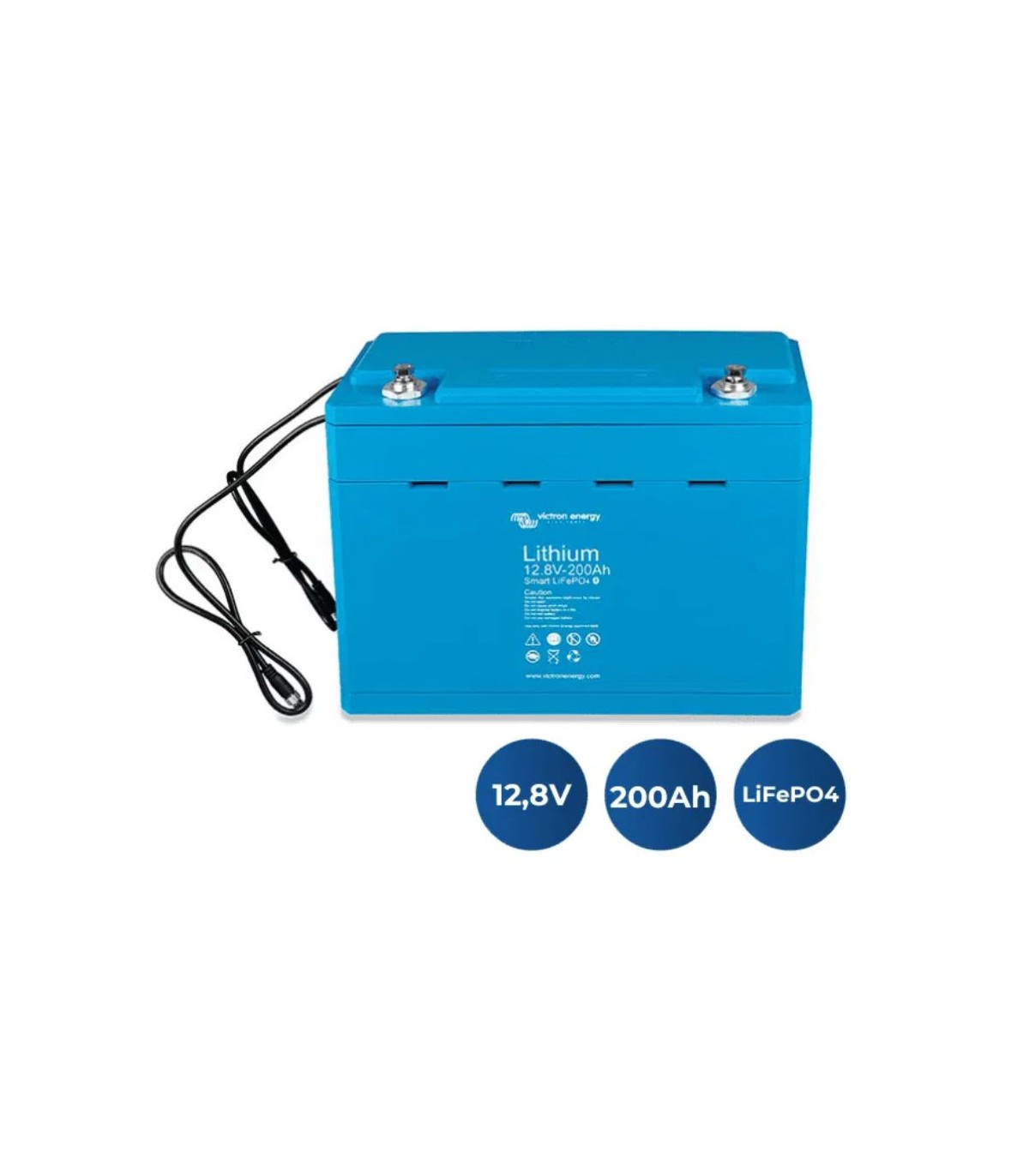

Battery Victron LifePo4 Smart 12,8V / 200Ah - BAT512120610
The iron and lithium phosphate batteries (LIFEPO4 or LFP) are the safest traditional Li-ion batteries. The nominal voltage of an LFP cell is 3.2V (lead-acid: 2V / cell). A 12.8V battery LFP, therefore, consists of 4 cells connected in series; and a 25.6V battery consists of 8 cells connected in series.
Robust
A lead-acid battery will fail prematurely due to sulfation if:
It works in deficit mode for long periods of time (that is, if the battery rarely or is never fully charged).
It is left partially loaded or, worse, completely discharged (yachts or caravans during the winter).
An LFP battery does not need to be fully charged. Its useful life will even improve in case it is partially instead of fully charged. This is a decisive advantage of LFP compared to lead-acid.
Other advantages are the wide range of work temperatures, excellent cyclic performance, low internal resistance and high efficiency (see below).
The chemical composition of LFP is the appropriate choice for very demanding applications.
€1,183.00
(tax incl.)
Reference:
522302120718
Brand:
Love0
Add to compare0
Add to wishlist
Efficient
In several applications (especially applications not connected to the network, solar and / or windows), energy efficiency can be of crucial importance.
The energy efficiency of the complete cycle (discharge from 100% to 0% and return to 100%) of a normal acid and lead battery is 80%.
The energy efficiency of the complete cycle of an LFP battery is 92%.
The loading process of lead-acid batteries becomes particularly inefficient when the load state of 80% is reached, resulting in 50% or even lower efficiencies in solar systems in which reservations are needed for several days (batteries running between 70% and 100% load).
On the contrary, an LFP battery will continue to achieve an efficiency of 90% under mild discharge conditions.
Size and weight
Save up to 70% of space
Save up to 70%
¿Expensive?
LFP batteries are faces compared to lead-acid. But if they are used in demanding applications, the high initial cost will be more than compensated for a greater life, superior reliability and excellent efficiency.
Bluetooth
Via Bluetooth can be monitored cell tensions, temperatures and alarm states.
Very useful to locate a (possible) problem, as an imbalance of cells.
Battery management system (BMS)
The BMS connects to BTV and its essential functions are:
It can generate a pre-alarm as long as the voltage of a battery cell fall below 3.1 V (adjustable between 2.85 V and 3.15 V).
Disconnect or off the load when the voltage of a battery cell drop below 2.8 V (adjustable between 2.6 V and 2.8 V).
Stop the loading process when the tension of a battery cell rises above 4.2V.
Turn off the system each time the temperature of a cell exceeds the 50º.
It requires one of the following BMS-ES:
Ve.Bus BMS - Recommended for systems with our investors / loaders.
Small BMS - Recommended for use in small systems.
Battery Management System BMS 12/200 - Recommended for use in automotive and marine systems with CC loads and alternators.
SMART BMS CL 12/100 - Recommended for use in automotive and marine systems with CC and alternators
Brand: Victron Energy
Battery: LIFEPO4
Battery capacity (AH): 200 ah
Battery voltage: 12.8 V
Compatible BMS: VE.BUS BMS / V2 - SmallBMS - Smart BMS / CL 12/100 (not included)
Maximum efficiency (%): 92
BluetoothYes
ON / OFF remote: No
Input connections CA / CC: M8
Dimensions and weight
Stop: 23.70
Width: 32.1
Long: 15.2
Weight: 19.5
 English
 Español
 Français
 Português PT
 Deutsch
 Italiano