

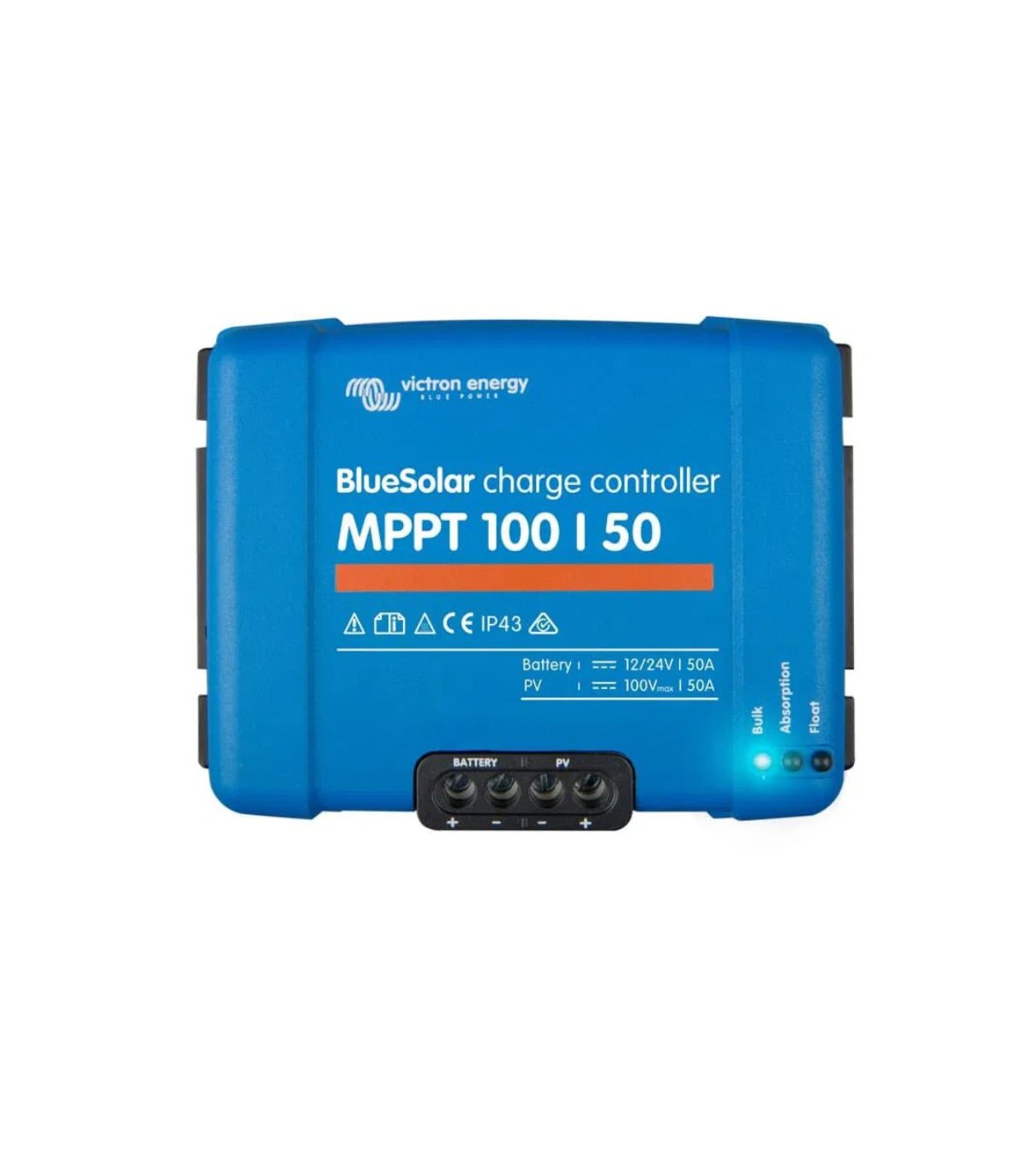

Load regulator Victron Blue Solar MPPT 100/50 (12/24-50a) - SCC020050200
A solar charger collects energy from its solar panels and stores it in a solar charger collects the energy of its solar panels and stores it in its batteries. Using the last and fastest technology, Blueesolar maximizes this energy harvest, leading it intelligently to achieve full load in the shortest possible time. BlueSolar maintains the health of batteries, lengthening its useful life.
€179.00
(tax incl.)
Reference:
522302120536
Brand:
Love0
Add to compare0
Add to wishlist
PWM and MPPT load regulators are widely used to charge batteries with solar energy. The PWM regulator is, in essence, a switch that connects a sunscreen with the battery. The result is that the panel voltage is approaching the battery. The MPPT regulator is more sophisticated (and more expensive): it will adjust its input voltage to harvest the maximum power of the solar set and then transform this power to supply the variable voltage required by the battery plus the load. Thus, basically uncoupling the tensions of the field and the battery, so that there may be, for example, a 12 volt battery on one side of the MPPT loading controller and serial-connected panels to produce 36 volts in the other.
In general, it is accepted that the MPPT will exceed the PWM in a cold weather climate, while both drivers will show approximately the same performance in a climate of subtropical to tropical. In addition to performing the function of a basic controller, an MPPT controller also includes a DC tension converter to DC, which converts the tension from the assembly into the battery required by batteries, with very little loss of power.
An MPPT controller tries to collect the energy of the set close to its maximum power point, while supplying the variable battery voltage requirements plus the load. Therefore, basically uncoupling the tensions of the field and the battery, so there may be a 12-volt battery on one side of the MPPT charging controller and two 12 V panels connected in series to produce 36 volts in the other. If it is connected to a photovoltaic field with a nominal voltage considerably higher than the battery, an MPPT controller will provide load current even at very high temperatures of the cells or under conditions of low irradiation, when a PWM controller would not help much.
As the set size increases, both the transverse section of the wiring and its length increase. The option to wire more panels in series and, therefore, reduce the current, is a weight ratio to install an MPPT controller as soon as the power of the assembly exceeds a few hundred watts (12 V battery), or several 100 watts (24 V or 48 V battery)
Brand: Victron Energy
Bluetooth: No
ON / OFF remote: No
Dimensions and weight
Width: 18.6
Long: 7
Weight: 1.53
 English
 Español
 Français
 Português PT
 Deutsch
 Italiano